
TRAINING INSIGHTS
The Power of Muscle (For health)
Your muscles do a lot more than you might think.
Marvel movies would have you believe a muscular physique is for mere “show” — impressive, perhaps, but only cardio was thought to help you live longer.
That view no longer holds up.
Strength training delivers real functional carryover to everyday life, especially paired with an active lifestyle. And beyond its ability to generate the strength and power that drive functional outcomes, muscle tissue itself can meaningfully improve our health.
Muscle tissue is a complex network of proteins controlled by our nervous system through electrochemical signals. There are three types of muscle in the human body.
Smooth muscle controls systems like digestion and blood flow without conscious effort. Cardiac muscle is the specialized muscle of the heart, constantly adjusting its activity in response to what the body needs. And then there’s skeletal muscle — the muscle attached to our bones that we can consciously control.
That’s the muscle we’re most interested in for health and fitness.
Muscular contractions run on ATP, the energy currency our macronutrients ultimately become, and they require tightly controlled mineral levels. These minerals are known as electrolytes, and a lucrative industry has sprung up around electrolyte products which claim to improve performance, boost cognition, and so on. Sodium, potassium and calcium genuinely are essential for contractions to occur, but most electrolyte supplements do little more than produce expensive urine. Although exercising in hot and humid environments can increase sodium excretion, most non-athletes get more than enough sodium through dietary sources. Repeated high-intensity effort releases hydrogen ions; once these build up, the muscle cell turns too acidic and function suffers. Regular training builds our capacity to buffer hydrogen ions, boosting our tolerance for sustained high-intensity work.
Here is the part most people don’t know: our muscles aren’t just hunks of meat — they’re chemical reactors, and they do far more than move weight.
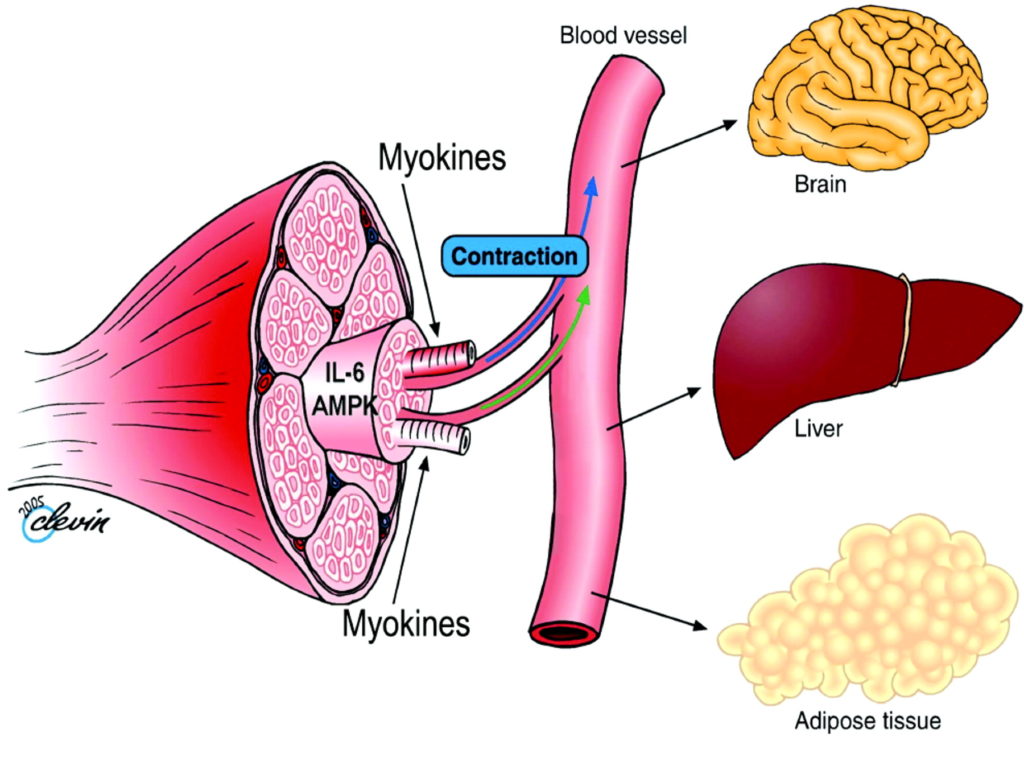
Here is the part most people don’t know: our muscles aren’t just hunks of meat — they’re chemical reactors, and they do far more than move weight.
Loading and usage trigger muscle tissue to release a range of molecules known as myokines. Research into their effects is ongoing, but here’s some of what we know so far.
One of the most studied myokines is IL-6 (Interleukin-6), interacting with a wide range of tissues and pathways.¹ It stimulates fat breakdown, reduces obesity-related inflammation, and improves glucose tolerance and insulin sensitivity. Rodent studies have even shown reduced tumor size in response to elevations in IL-6, but we should be cautious about extrapolating these results to humans without further direct research.
Resistance training also changes how we handle glucose.
IL-6 is just one of many myokines that regulate hormones and metabolic processes. Insulin, for example, clears glucose from the bloodstream and delivers it to tissues throughout the body; resistance exercise improves tissue sensitivity to insulin, while muscle itself acts as a glucose sink, preventing excess buildup in the blood. Resistance training can even shuttle glucose into tissues independently of insulin, via GLUT-4 receptors on muscle cell membranes. These effects pair with increased fat oxidation: resistance training reduces both intramuscular fat and, crucially, visceral fat — the fat deposited around and within organs that impairs metabolic health, drives inflammation, and strongly predicts disease risk.
Resistance training also strengthens cardiovascular health: it increases cardiac output, expands blood volume, and remodels capillaries — delivering more blood to tissues and clearing metabolic waste more efficiently.
All of these systems interact.
That’s what makes it difficult to point to one hormone, one myokine, or one mechanism and say, “This is why resistance training works.” The body doesn’t work in isolation. Improving muscle mass, strength, insulin sensitivity, cardiovascular health, and body composition creates a network of adaptations that support one another.
And you don’t need to train like an athlete to get started.
If you’re currently doing little or no resistance training, one or two full-body sessions of around 45 minutes a week can produce meaningful improvements in strength and physical capacity. You can do more as you become fitter and stronger, but you don’t need to start there.
This matters because starting small makes it easier to keep going.
As we discussed in our previous article, motivation is built through repeated experiences. Going from sitting on the sofa to training five days a week is a big leap. Going from doing nothing to two sessions a week is much easier.
You get stronger. You notice the difference. Everyday tasks become easier. Those results give you a reason to come back.
Over time, the habit becomes easier to maintain.

Improving strength and bone density through resistance training helps preserve physical capacity and quality of life as we age. But muscle itself is also an important part of our metabolic health.
The muscle you build isn’t just for show.
It’s working for you around the clock.
References
¹ Hoffmann, C., & Weigert, C. (2017). Skeletal Muscle as an Endocrine Organ: The Role of Myokines in Exercise Adaptations. Cold Spring Harbor perspectives in medicine, 7(11), a029793. https://doi.org/10.1101/cshperspect.a029793