
TRAINING INSIGHTS
How Hard You Should Be Training?
By Shane O'Dwyer
If you’ve been around the Iron Game for a while, or you’re even just bro-curious, you’ve probably wondered about the best way to build muscle and strength. Unfortunately, the answer is never just about what you do in the gym. Sleep matters. So does stress. Protein and calorie intake matter. Your overall activity level matters. And, because life isn’t fair, genetics matter too.
In this article, we’re going to stick with the part we can control most directly: picking things up and putting them down. More specifically; how much should you do, and how hard should you do it?
More or Harder?
Although the concept of training volume has been discussed for a long time, it continues to be a contentious topic. It is clear that volume plays some role in resistance training adaptations- one set will get you more gains than no sets, after all. But after that, it can be surprisingly hard to find consensus between individuals on what is the right amount of training volume for a given individual. Devotees of Mike Mentzer and Dorian Yates will claim that one hard set taken close to failure is all anyone needs. Others, perhaps inspired by the epic videos of Arnold’s arduous training in his Golds’ Gym heyday, insist that high volumes are essential to achieve best results. So, who is right? As we will see, a definitive answer might not be so simple, but nowadays we do have some good evidence to help guide our decisions.
Although training volume has been discussed for decades in sport science circles, the literature on the topic was surprisingly sparse until recent years. In general, training volume was discussed for sports performance in track and field, Olympic weightlifting, and other sports dependent on maximal output. In running nomenclature, volume might refer to total mileage, or the number of runs at a given temp or percentage of maximal heart rate. This concept of intensity was inherently tied to any discussion around volume. Intensity refers to the effort of a given performance relative to an individual’s maximum ability. In powerlifting or weightlifting intensity generally refers to a weight that is a percentage of an individual’s one-repetition maximum for a given exercise. There is an inherent interaction between volume and intensity; as the intensity of an athlete’s training increases, they will generally need to reduce the amount of work they do, the volume.
Given that bodybuilding is a relatively niche sport- depending on how you define ‘sport’- research which addresses how the above factors influence muscle growth has been extremely limited until the last two decades or so. Fortunately, that is starting to change.
Recall that intensity is relative to maximal performance, and varies between individuals. Some people can tolerate more hard training than others, but the general principle still holds that volume and intensity should be adjusted in relation to one another. Advocates of the Mentzer approach take the view that intensity, not volume, is the primary driver of muscle growth. This High Intensity Training (HIT) approach promotes simply taking one heavy set to failure once every 7-10 days, rather than performing multiple sets per session. Note that this definition of intensity is different to that of powerlifting, where intensity is expressed as a percentage of one-repetition maximum (%1RM). In a bodybuilding context intensity is often framed as how close to failure you are getting to during a set with any given weight.
On the other end of the spectrum is a training method like German Volume Training (GVT) which prescribes 10 sets of 10 reps. This approach embraces volume, sheer workload, as the main driver of muscle gain. This approach considers volume as a function of weight multiplied by sets multiplied by repetitions completed, which is known as Volume Load.
While some very big and strong individuals have had great success with both of these approaches, and many other variations on the same theme, both sides are probably guilty of misunderstanding one another. As outlined above, HIT is actually referring to how difficult a set is, not necessarily the weight on the bar. As such, intensity in this context can better be described as Proximity to Failure, where the goal is to achieve failure on each working set.
Although volume load can be a valid way of measuring the overall work completed during a training session, or over a training block, it does not tell the whole story.
If we were to use the example of GVT, for an individual to be able to complete 10 sets of 10 reps with a given weight, they will have to be much further from failure during the first few sets than the last few.
To put this in perspective, let’s say a given athlete can perform a Barbell Bench Press with 135lb/60kg for 18 reps before hitting failure. If we were to express proximity to failure as Repetitions in Reserve (RIR), then an individual using this weight for 10 x 10 might look something like this:
Set 1: 10 x 135lb (RIR 8)
Set 2: 10 x 135lb (RIR 7)
Set 3: 10 x 135lb (RIR 7)
Set 4: 10 x 135lb (RIR 5)
Set 5: 10 x 135lb (RIR 4)
Set 6: 10 x 135lb (RIR 3)
Set 7: 10 x 135lb (RIR 3)
Set 8: 10 x 135lb (RIR 2)
Set 9: 10 x 135lb (RIR 1)
Set 10: 10 x 135lb (RIR 1)
In this example, this individual is training pretty comfortably for the first 4-5 sets of this exercise, before really exerting themselves for the last 3 sets. Although they would have accumulated a significant volume load, a HIT advocate could pretty reasonably make the claim that this trainee is only really exerting themselves on the last two of those ten sets. If the trainee were to use longer rest intervals of 3-5 minutes, they may be able to recover enough where they are still at RIR 5 for the last sets.
One of the reasons that proximity to failure is considered so important for hypertrophy is that getting closer to failure will recruit a greater proportion of muscle fibers in a given muscle. Recruiting more muscle fibers during a set will expose more of these fibers to Mechanical Tension, and it is probably mechanical tension which we should be focused on. In this framing, intensity and proximity to failure are simply a proxy measure of the mechanical tension of any given set. Volume, or the number of sets, is another metric for measuring the dose of this mechanical tension.
In perhaps the most comprehensive meta-analysis on the relationship between volume and muscle growth and strength, Pelland and colleagues (2026) found a positive relationship between weekly training volume and changes in muscle size. When viewed graphically, however, there is an incremental flattening of this line as training volumes increase. The authors observed that just 4 weekly sets per week was enough to elicit meaningful hypertrophy.
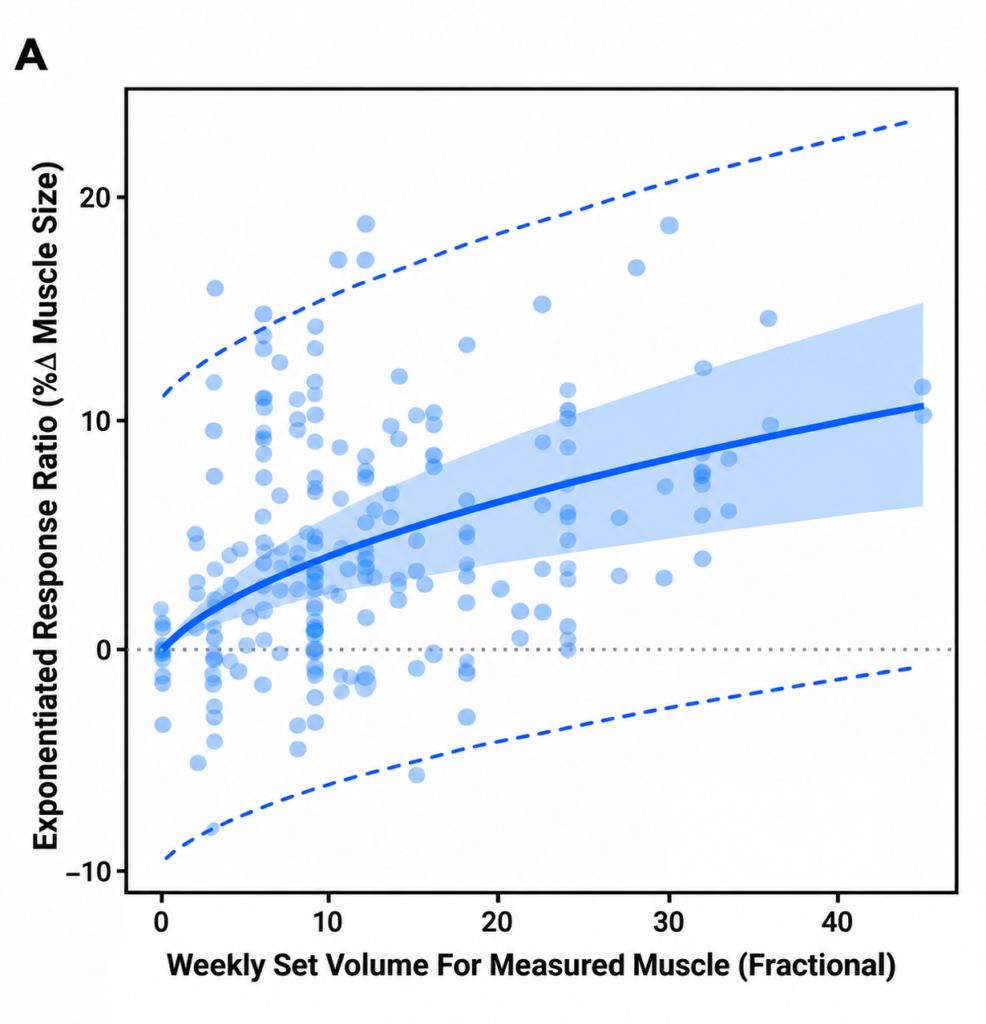
While higher volumes were associated with greater muscle growth, there was a progressively worse ‘return on investment’. Although increased hypertrophy continued to be observed with 43+ sets per muscle group per week, this would be something like 10 times more work per week for about 4% more growth compared to the minimally effective dose. Also, very few studies with these kinds of volumes have been conducted, so we probably shouldn’t place too much confidence in that specific target.
Low-to-moderate volumes of 6-10 sets per muscle group are an effective option for most casual trainees trying to improve their physique, a training load that could easily be achieved in two full-body sessions per week. More dedicated individuals might err slightly closer to a range of 11-18 sets per muscle group per week, as long as they are not expecting miracles from this substantial increase in training time. Individuals interested in wringing out every bit of muscle growth they can might aim for 19-29 sets per muscle group per week, but this requires substantially more time to achieve. One could even experiment with periods of cycling higher volumes for certain body-parts, but this requires sufficient time, intelligent programming, and a borderline worrying obsession with maximizing muscle growth at all costs.
At very high volumes it becomes increasingly difficult to maintain a high degree of effort for each set, especially when training the same muscle group four or five times per week. As we have discussed, training closer to exposes more muscle fibers to mechanical tension over the course of a set, and improves the efficiency of any given set (Robinson et al., 2024). This scenario brings us right back to where we started: is it better to train as hard as possible on one or two sets, or do as many sets as possible?
Hopefully, we can accept a middle ground. You will almost certainly get better results performing more than one or two sets per muscle group per week. Aiming for between 6-10 sets per muscle group is a perfectly viable option for most people, but for best results these sets should probably be taken pretty close to failure, maybe with one or two repetitions in reserve. Hopefully, this goes without saying, but some exercises are better choices for training to failure than others: the risks from failing a set of leg extensions are pretty low, while failing on squats or bench press could be catastrophic.
Individuals who are more focused on muscle growth and who have the time and motivation to train multiple times per week might want to venture into the higher volume territory of 11-18 sets per week. While this volume is certainly nothing too crazy in bodybuilding circles, a trainee might also choose to slightly reduce the average training intensity of the program to avoid joint pain, or simply to avoid feeling too burnt out. For example, they might aim to be 1-3 reps away from failure on each set, or take one set per exercise to failure while keeping a few reps in reserve on other sets.
As volumes get progressively higher, the picture becomes increasingly murky. Although someone might generate marginally greater muscle growth with 30 sets compared to 15, it is difficult to say whether this difference would be even visually noticeable in real life. Devoting two to three time and effort to training for an extra one to two centimeters of muscle growth might be worth it for a very small number of people, but this is likely not the best trade-off for non-obsessed bodybuilders. Training multiple muscle groups with high volumes for weeks at a time could also lead to a recovery bottle-neck where joints and connective tissues simply cannot keep up with the training load. Developing chronic joint pain is a surefire way to reduce training intensity and volume in one fell swoop. As such, the short term pursuit of very high training volumes can seriously curtail training quality in the medium to long term.
Ultimately, how much and how hard you should train will come down to many factors. Highly driven maximizers with a schedule that allows for multiple 2-hour workouts per week might be perfectly happy to train with 30+ sets per muscle group per week for a hypothetical 5% increase in muscle growth compared to doing half that amount. The majority of trainees can make substantial gains in muscle with perhaps 8-12 exercises per muscle group per week divided into 2-3 sessions. Many people can continue to make progress with as few as 4 sets per muscle group per week, but in these cases it probably becomes more important to take those sets as close to failure as possible.
Being honest with yourself about how hard you are training and collaborating with a good coach to guide training decisions is one of the best ways to ensure you are getting your best possible results. While many roads can lead to Rome, some can get you there faster, or with fewer injuries along the way. So, how hard should you be training? Hard enough to get results.
References
Pelland, J. C., Remmert, J. F., Robinson, Z. P., Hinson, S. R., & Zourdos, M. C. (2026). The Resistance Training Dose Response: Meta-Regressions Exploring the Effects of Weekly Volume and Frequency on Muscle Hypertrophy and Strength Gains. Sports medicine (Auckland, N.Z.), 56(2), 481–505. https://doi.org/10.1007/s40279-025-02344-w
Robinson, Z. P., Pelland, J. C., Remmert, J. F., Refalo, M. C., Jukic, I., Steele, J., & Zourdos, M. C. (2024). Exploring the Dose-Response Relationship Between Estimated Resistance Training Proximity to Failure, Strength Gain, and Muscle Hypertrophy: A Series of Meta-Regressions. Sports medicine (Auckland, N.Z.), 54(9), 2209–2231. https://doi.org/10.1007/s40279-024-02069-2